Book, magazine or album, what the presentation changes for the reader
Published on 3 min read
A thirty-page report stapled in one corner and the same text bound in a hard cover contain the same words. The first slips into a bag and opens with one hand. The second sits on a table and stays open at the chosen page. Binding, paper and cover give each one its own way of being held and leafed through.
What binding and paper give a document
A bound volume keeps its pages tight against the spine, and they turn with a certain restraint. A booklet of a few stapled sheets opens fully and is quick to go through, forwards or backwards. An album is made to open flat, so that an image spread across two pages does not disappear into the fold.
Paper plays its part too. A cream, matte paper suits long pages of text. A glossy paper reflects the light and gives photographs brighter colors. That is how a novel and a magazine can be told apart before they are even opened.
Six presentations on screen
Ostibook brings these differences into six modes. The Book has thickness, a cream paper, and pages that turn slowly. The Brochure is thin and white, and its pages go by quickly. The Report is quicker still, on a neutral background with little shadow, which suits a long document.
The other three modes are designed for images. The Catalog keeps its pages very sharp and gives the images all the room. The Magazine has a glossy paper with a slight sheen. The Album opens flat, with large, thick sheets and a cloth cover.
The cover does not behave the same way in every mode. The Book, the Catalog, the Magazine and the Album show it on its own, then open onto two pages. The Brochure and the Report open straight onto two pages, like a document being unfolded.
Trying it with your own pages
The mode changes how the document looks and leaves its content as it is. On the Create page, once your file is open, you can switch from one mode to another and leaf through the result. Your layout does not have to be redone, and the choice can be changed until you export.
To compare two modes, look at a page of dense text, then at an image that fills the whole page. The paper and the speed of the page turn are easier to notice there than on the cover.
The works in the gallery
The gallery shows each mode on a complete publication. The Tale of Mrs. Tiggy-Winkle, by Beatrix Potter, is shown there as a Book, with its 94 pages. A catalog of plants and seeds from 1886 is shown as a Catalog. Earth as Art, a collection of satellite images of the Earth, can be leafed through as an Album over 172 pages.
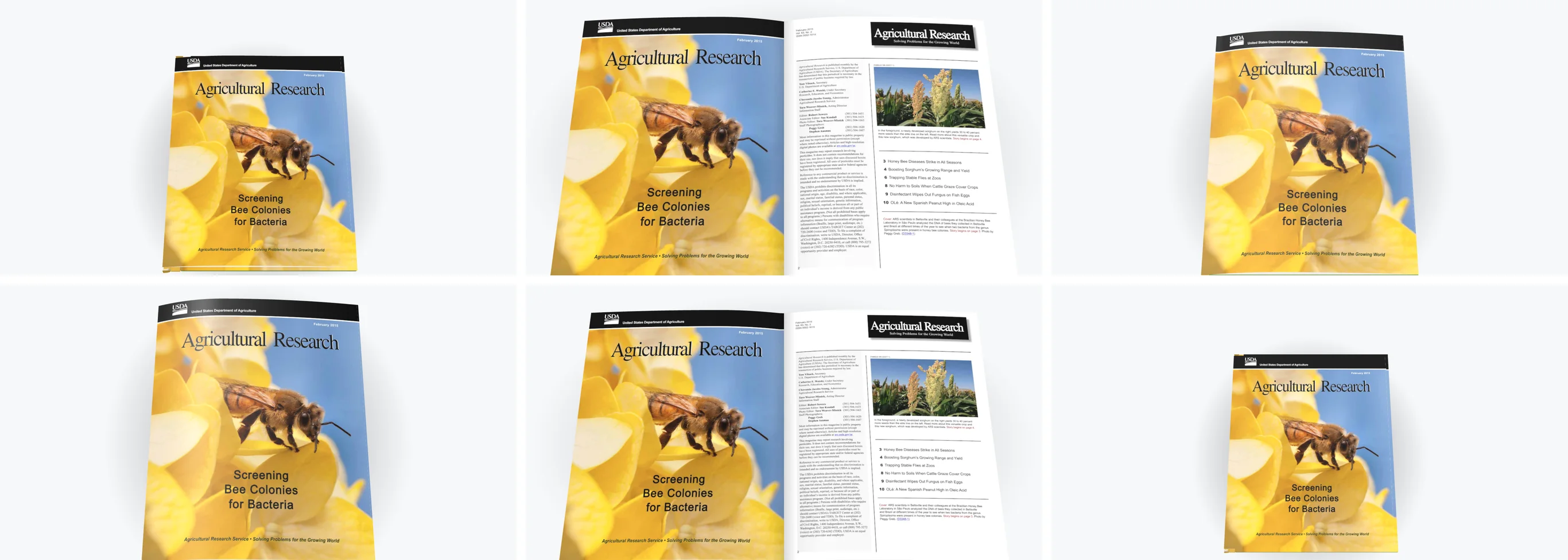
An issue of the journal Agricultural Research is shown as a Magazine. The 2023 annual report of the Direction interministérielle du numérique and a booklet from the Guild of Handicraft, printed around 1902, are shown as a Report and a Brochure.